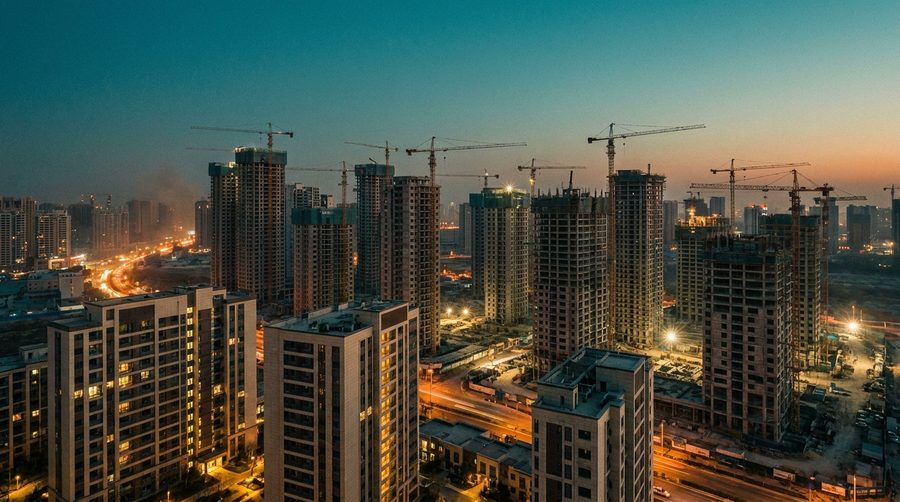
Asunción is delivering more than 50 new residential buildings a year, entry units start around $62,900, and the marketing decks quote yields "up to 14%." All three numbers are real. None of them tells you what can go wrong. This piece does.
We curate Asunción property for buyers who live somewhere else, and the fastest way to lose one of those buyers is to sell them a fantasy. Early-cycle markets reward preparation and punish assumption. So here is the version a sales page will not give you: every genuine risk of buying here, and what actually reduces it.
Construction Delay
The risk. Buildings run late. In a market pouring this much concrete this fast, contractors, materials, and municipal sign-offs all get stretched, and a promised delivery date can slip by months. If you underwrote your return on a specific handover, that slip costs you rent and patience.
The mitigation. Read the contract before you read the brochure. A serious pre-construction agreement names a delivery date and attaches a penalty when the developer misses it. Ask what that penalty is and whether it is enforceable. Then weight your decision toward developers who have actually finished buildings — a delivered track record is worth more than a beautiful render. Delay is common; unbounded delay with no contractual consequence is a choice you can decline.
Developer Default
The risk. This is the one that matters most in pre-construction. Not a late building — a building that never gets finished, from a developer who runs out of money or disappears. Your capital is exposed for the entire construction period, and recovering it is slow and uncertain.
The mitigation. Three habits, stacked. First, verify through an escribano — a public notary whose job is confirming the title, the permits, and who legally owns what. That review costs a few hundred dollars and is the cheapest insurance you will ever buy. Second, structure payments in stages tied to construction milestones rather than a large upfront lump; staged money keeps the developer accountable and limits what is at risk at any moment. Third, favor developers with delivered buildings you can walk through. A firm that has handed over real keys to real owners has more to lose than a first-timer with a slideshow.
Thin Resale Liquidity
The risk. The resale market here is younger and thinner than a mature capital. Fewer secondary buyers are circulating, so selling can take longer and you have less pricing leverage the day you want out. This is the risk you cannot fully engineer away.
The mitigation. Buy on a horizon of five years or more, and mean it. Do not put money here that you might need back in eighteen months. Then buy what renters actually want — sensible layouts, working locations, the unit that stays occupied — because a property that rents easily is also the property that sells more easily when the time comes. You reduce this risk by being patient and by buying quality. You do not eliminate it. Accept that going in.
A Young Rental Market
The risk. Rental demand looks healthy, but the data behind it is short. There is not a long history of occupancy and rent movements to lean on, which means any yield figure you are handed is an estimate of where the market is, not a promise of what your unit will earn.
The mitigation. Underwrite conservatively. Ignore the headline yield and build your own numbers off long-term rental comparables for similar units in the same district — actual signed leases, not projections. Assume some vacancy. If the deal still works on cautious assumptions, the upside is a bonus rather than a requirement. Yields in the range of 5 to 7 percent across the city and 7 to 12 percent in stronger investor districts are what the market is showing now; treat them as inputs to test, not guarantees to bank.
Potential Oversupply
The risk. More than 50 new buildings a year is a lot of inventory to absorb. Some corridors will digest it fine. Others will see too many similar units competing for the same tenants, which pressures rents and slows resale in exactly the pockets that got overbuilt.
The mitigation. District and micro-location beat project selection. The building matters less than the block it sits on, the walkability around it, and how much competing supply is going up within a few streets. A strong developer in a saturating corridor is a weaker bet than a decent developer in a location with real, durable demand and limited new construction. Choose the map first, the building second.
Currency
The risk. The guaraní strengthened roughly 17 percent against the US dollar in 2025. Currency moves both ways, and a swing in either direction can quietly reshape your real return when you eventually convert back.
The mitigation. The Asunción property market prices largely in US dollars, which works in your favor if you are a dollar-based buyer. Keep your contract dollarized — purchase price, staged payments, and ideally rent denominated or benchmarked in USD — so that a currency move does not become a hidden term of your deal. You are not going to forecast the guaraní. You can refuse to let it float through the middle of your contract.
Information Asymmetry
The risk. The seller knows more than you, and the gap shows up in polished renders that flatter the finished reality and in marketing that quotes yields "up to 14 percent" without saying under what assumptions. In a market that is still maturing, the distance between the pitch and the property can be wide.
The mitigation. Close the gap with independent eyes. An escribano and your own legal review answer to you, not to the developer. Underwrite skeptically: discount the top-line yield, verify the comparables yourself, and treat every render as a best case. The buyers who lose money here are almost never the ones who did too much diligence.
Why People Take These Risks Anyway
Set against the risks is a specific set of reasons the numbers keep pulling international buyers in. Paraguay's economy grew 6.6 percent in 2025, the fastest in the region. It earned an investment-grade rating from Moody's the same year and carries the lowest public debt in Latin America. Apartment penetration sits at 12.7 percent, which is another way of saying most of the demand has not been built for yet. Prices run roughly $900 to $1,800 per square meter, against $3,000 to $5,000 in Buenos Aires or Santiago. Yields land at 5 to 7 percent in the city and 7 to 12 percent in investor districts, and rental income is taxed at a flat 10 percent.
That is the trade. You are buying into a market that is cheaper, faster-growing, and less built-out than its neighbors, and paying for it in liquidity and maturity. Whether that trade is good depends entirely on your time horizon and your discipline.
FAQ
Is Paraguay safe to invest in? The country carries an investment-grade rating and the lowest public debt in Latin America, and grew 6.6 percent in 2025. Property-level risk is real — delay, default, thin resale — but most of it is reducible through escribano verification, staged payments, delivered-track-record developers, and conservative underwriting.
What is the biggest real estate risk in Paraguay? In pre-construction, developer default: a building that is never finished. It is why staged payments, escribano title checks, and preferring developers who have already delivered buildings matter more than any yield projection.
Can I sell Asunción property quickly if I need to? Not reliably. The resale market is younger and thinner than a mature capital, so plan on a horizon of five years or more and buy units that rent easily — those are the ones that also sell more easily.
An early-cycle market pays you for doing homework. The risks here are real, knowable, and mostly reducible — every one except liquidity, which you simply have to accept and plan around. For the full picture on districts, pricing, and process, download the free Paraguay Investment Guide. It is the reading we would want to do before wiring money anywhere.